
When Does Assault become a Serious Physical Assault for a Reportable Conduct Finding?
When an allegation involves an employee applying physical force against a child, working out whether it meets the definition of assault is only the first step. The harder, and often more consequential, question is whether that assault crosses the threshold into a “serious physical assault”. Getting this classification right shapes how the finding is documented, who has to be told about it, and what happens to the employee once the investigation ends.
This article works through both definitions under the NSW Reportable Conduct Scheme, the exceptions that take an incident out of the scheme altogether, and a practical checklist you can use when you're looking at a set of findings and trying to work out where they land.
What Counts as Assault Under the Reportable Conduct Scheme in NSW
Under section 25 of the Children's Guardian Act 2019, conduct amounts to a reportable allegation of assault where an employee
1. intentionally or recklessly applied physical force against a child without lawful justification or excuse, or
2. caused a child to apprehend the immediate and unlawful use of physical force against them.
The first defenition covers actual contact, such as hitting, striking, kicking, punching, dragging or choking. The second definition doesn't require any contact at all. A threatening gesture or word that makes a child believe force is about to be used against them can meet the definition of assault on its own.
When is Physical Force not Reportable Conduct?
There are two situations that take physical force outside the scheme.
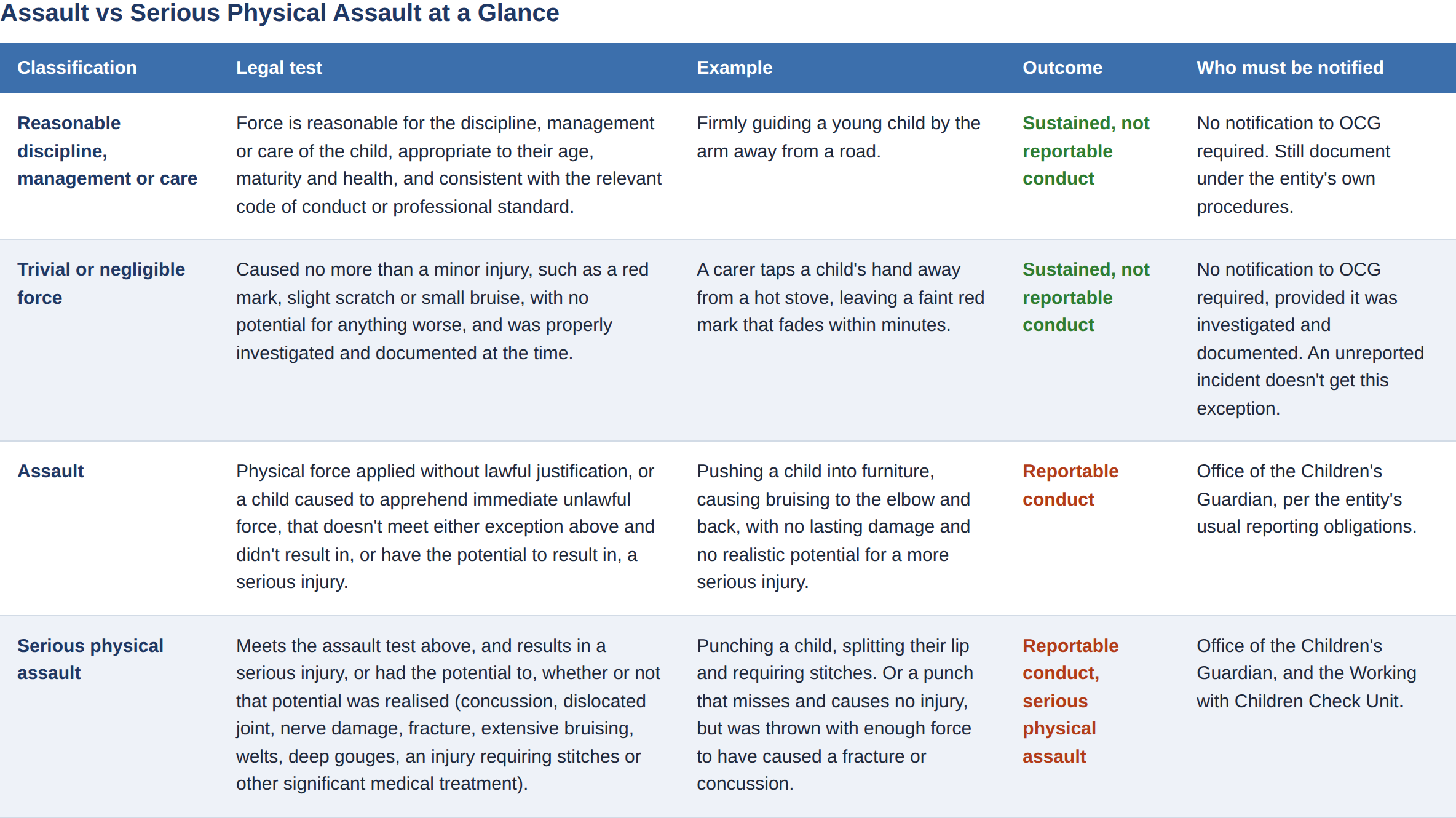
The first is force that's reasonable for the discipline, management or care of the child, appropriate to their age, maturity and health, and consistent with any relevant code of conduct or professional standard. For example a staff member physically grabbing a young child away from a road in order to protect them from being hit by a car isn't reportable conduct.
The second is force that's trivial or negligible, meaning it caused no more than a minor injury such as a red mark, a slight scratch or a small bruise, and had no potential to cause anything worse. This exception only applies if the incident is properly investigated and documented under the entity's own procedures. An incident that was never reported doesn't get the benefit of this exception simply because nobody followed it up.
Where either exception applies, the usual outcome is a finding of sustained but not reportable conduct.
What Makes an Assault a Serious Physical Assault?
An assault becomes a serious physical assault where it:
results in a serious injury, or
had the potential to result in one, whether or not that potential was realised.
A serious injury includes concussion, dislocated joints, nerve damage, fracture, extensive bruising, welts, deep gouges, injuries requiring stitches, or injuries requiring other significant medical treatment.
The potential to result in serious injury is the one decision makers tend to underuse. It's tempting to look only at the injury that actually occurred and classify the finding accordingly. A punch that happened to result in a minor injury may still have been capable of causing a fracture or concussion. The test asks what the force used was capable of doing, not just what it happened to do on this occasion.
Three Examples
A carer smacks a child on the leg, leaving a transient red mark that fades within minutes. Investigated and documented at the time, this would likely sit in the trivial or negligible category, sustained but not reportable conduct.
An employee pushes a child into a cabinet, causing bruising to the elbow and back. There's no lasting damage, but the force wasn't reasonable discipline and wasn't trivial. This is assault, not serious physical assault.
An employee punches a child, splitting their lip and requiring stitches. This meets the serious injury threshold directly. Even if the punch had missed and caused no injury at all, the potential for a serious injury from that level of force would likely still classify it as serious physical assault.
A Checklist for Classifying an Assault Finding
Why Getting the Classification Right Matters
A finding of serious physical assault has to be reported to the Working with Children Check Unit, on top of the entity's usual reporting obligations to the Office of the Children's Guardian. Misclassifying a serious finding as a straightforward assault risks under reporting something the regulator needs to know about. Misclassifying a trivial or reasonable incident as reportable conduct risks a finding that doesn't survive review, and an employee who has been through a process they should never have been subjected to.
This article is general information about the NSW Reportable Conduct Scheme and isn't legal advice. Entities should apply the legislation and their own policies to the specific facts of each matter, and seek advice where the classification is unclear.
We run free training on writing allegations, covering structure, particularisation, and the drafting errors that hand respondents a procedural fairness argument. You can access it here: https://www.insightinvestigations.com.au/free-training-allegation-writing