
Reportable conduct: what organisations need to understand before an allegation is made
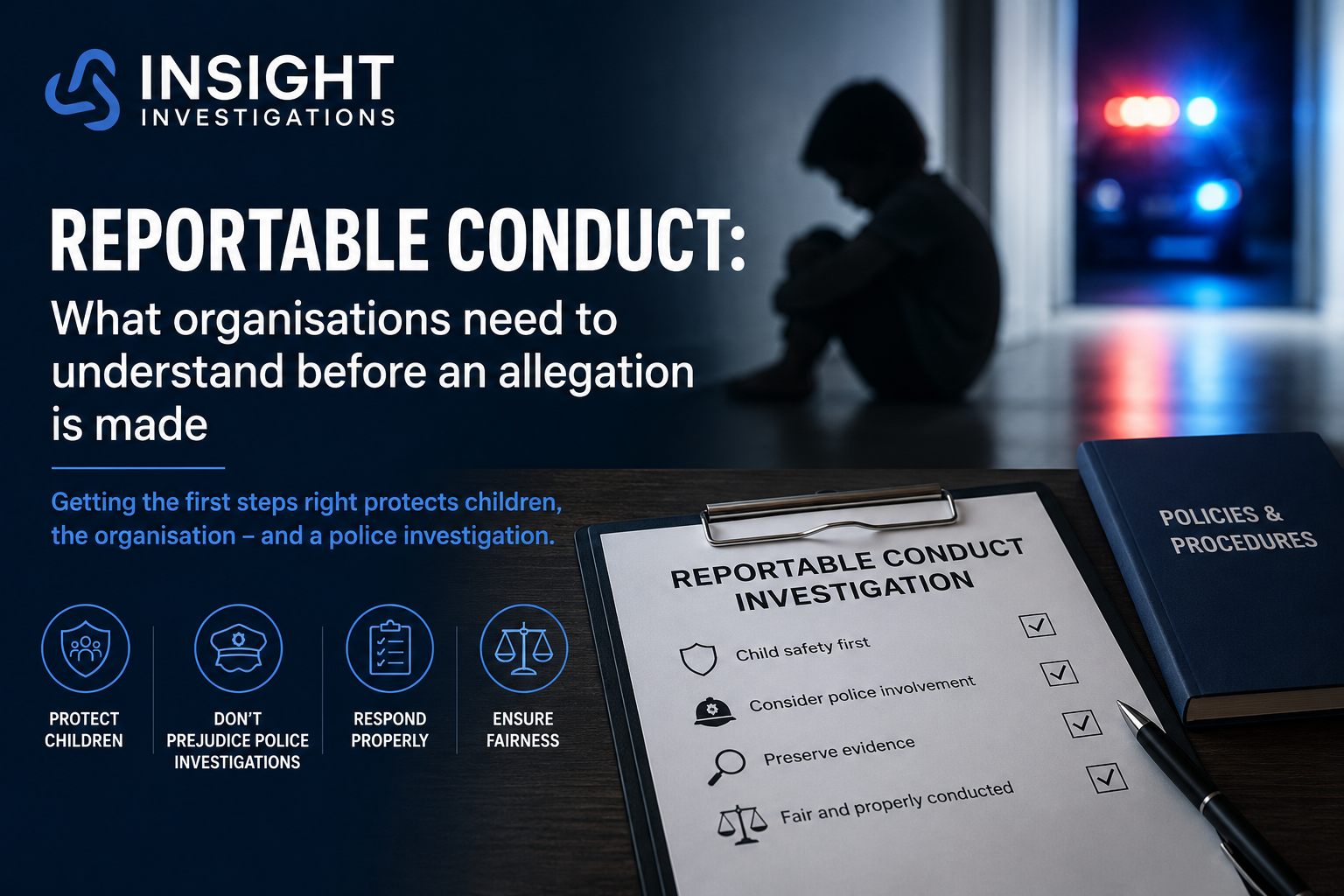
Many organisations do not think closely about reportable conduct until a serious allegation is made about a worker, volunteer or contractor.
By that stage, decisions often need to be made quickly.
Is there an immediate risk to a child?
Does the matter need to be reported to police, a child protection authority or a regulator?
Should the worker be removed from child-facing duties while the matter is assessed?
Who should speak to the complainant, the child, the worker and any witnesses?
What documents, messages or electronic records need to be preserved?
Those early decisions can shape the whole matter. In some cases, they can also affect whether a police investigation is protected or compromised.
Reportable conduct schemes are not only concerned with whether misconduct occurred. They are also concerned with how organisations identify, report, investigate and respond to allegations involving children and young people.
Reportable conduct is not just an HR issue
Reportable conduct matters often arise in employment settings, but they should not be treated as ordinary workplace complaints.
A complaint about interpersonal conflict, poor communication or performance management may be able to be managed through an internal HR process. A complaint involving alleged conduct towards a child or young person may trigger different obligations.
Depending on the jurisdiction and the nature of the allegation, reportable conduct may include conduct such as sexual misconduct, physical assault or violence, ill-treatment, neglect, psychological harm, or other conduct that raises child safety concerns.
Although reportable conduct schemes differ between jurisdictions, the core issue is similar: organisations that work with children need proper systems for identifying, reporting, investigating and responding to allegations involving workers and children.
The first assessment is critical
When an allegation is received, the organisation should not jump straight to an investigation interview.
The first step is usually a careful triage process. That process should consider:
whether there is an immediate risk to any child or young person
whether any interim action is needed to manage risk
whether police or child protection authorities need to be contacted
whether the allegation falls within the relevant reportable conduct scheme
whether a notification to the regulator is required
what evidence needs to be preserved
who is appropriate to assess or investigate the matter
how confidentiality and procedural fairness will be managed.
This does not mean the organisation needs to have all the answers immediately. It does mean the organisation needs a structured process for making early decisions and recording the reasons for those decisions.
One common problem is that organisations start gathering information informally before they have decided what process they are following. A manager may speak to the worker, ask questions of witnesses, or make comments that later create confusion about whether the matter was being investigated, performance managed or simply discussed.
In reportable conduct matters, that can create real difficulties. Witness accounts may be affected. The respondent may receive incomplete or inaccurate information. The organisation may fail to preserve important records. The regulator may later ask why particular steps were taken, or not taken.
Do not accidentally interfere with a police investigation
Some reportable conduct allegations may also involve alleged criminal conduct.
This is one of the most serious early risk points for an organisation. If the allegation may involve a criminal offence against a child or young person, the organisation should consider whether police need to be contacted before any internal investigative steps are taken.
The risk is not theoretical.
An organisation that starts interviewing witnesses, speaks to the respondent, collects evidence informally, or alerts people to the allegation before police have been consulted may compromise a police investigation.
In some cases, it may affect the integrity of witness evidence, create opportunities for collusion, or alert a person of interest before police have had the opportunity to take appropriate steps.
This does not mean an organisation does nothing.
The organisation still needs to consider immediate child safety, risk management, mandatory reporting and reportable conduct notification obligations. However, where police may be involved, those steps should be carefully coordinated.
Before the first interview is scheduled, the organisation should ask:
Could the alleged conduct be criminal?
Has the matter been reported to police?
Have police confirmed whether they are investigating?
Have police given clearance for the organisation to proceed?
Are any proposed risk management steps likely to alert the respondent or affect evidence?
Has the organisation documented the advice received and the reasons for the steps taken?
In reportable conduct matters, speed is important. But speed without coordination can cause damage.
A well-intentioned but poorly timed internal investigation can create serious problems for the organisation, the alleged victim, witnesses, the respondent and any later criminal process.
Preparation reduces risk
Organisations that work with children should not be designing their reportable conduct process for the first time after a serious allegation is received.
At a minimum, organisations should have:
a clear internal escalation process
staff who understand when an allegation may be reportable
a process for assessing immediate child safety risks
guidance about when police or child protection authorities should be contacted
guidance about preserving evidence
templates for allegations, interview plans and investigation reports
clear decision-making responsibilities
access to appropriately skilled internal or external investigators.
Good systems do not prevent every allegation. They do, however, reduce the risk of confused decision-making, unfair process, missed reporting obligations, compromised evidence and poorly supported findings.
Final point
Reportable conduct matters require careful handling from the start. The early response should be structured, calm and properly documented.
For organisations, the key question is not only:
“What happened?”
It is also:
“Have we responded in a way that protects children, meets our obligations, preserves the integrity of any police process and provides a fair process?”
Insight Investigations conducts independent workplace and reportable conduct investigations for organisations across Australia.
For assistance with a reportable conduct matter, contact alex@insightinvestigations.com.au or visit www.insightinvestigations.com.au.