
10 Things Every HR and Safeguarding Professional Should Know About Reportable Conduct Investigations
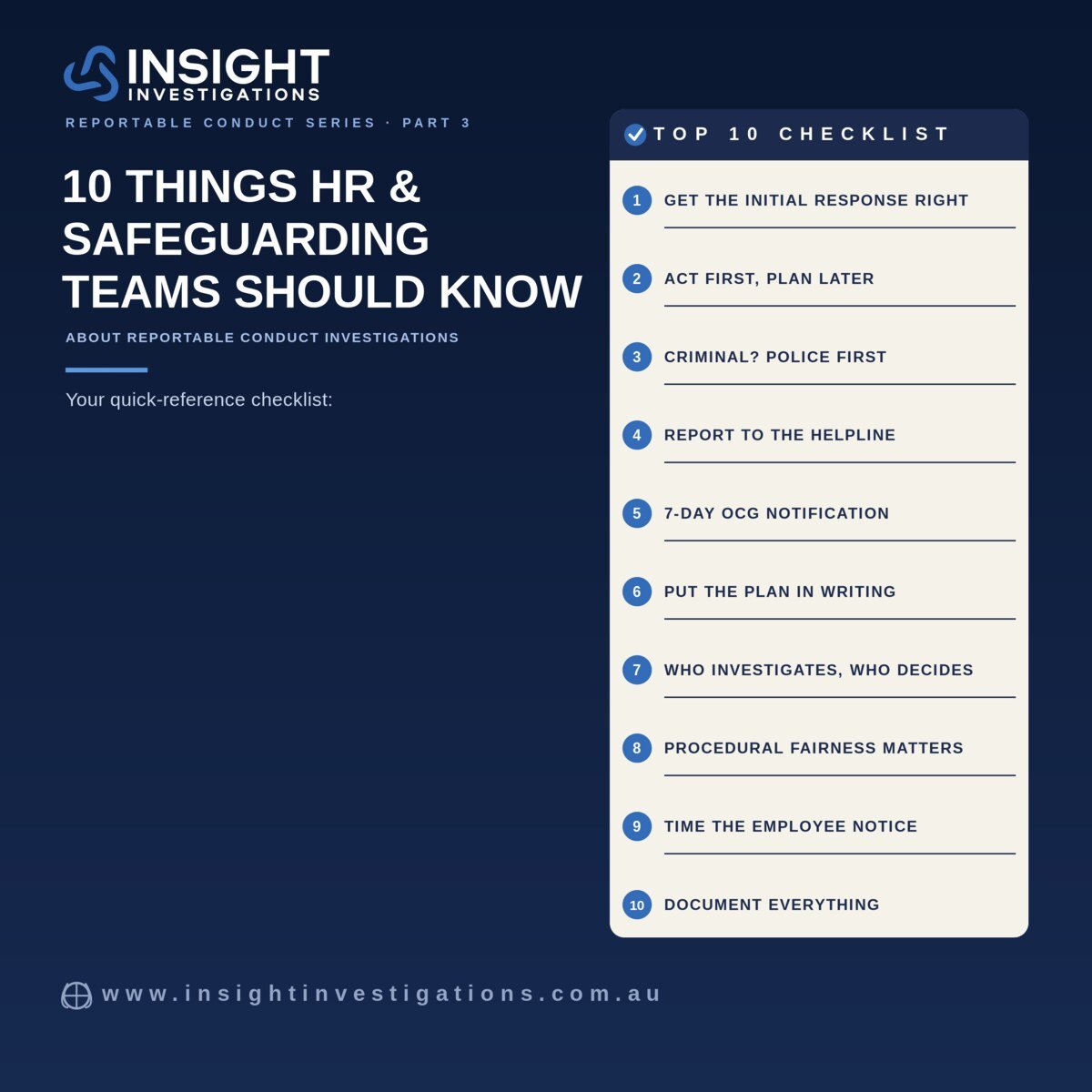
Ten Things You Should Know About Reportable Conduct Investigations
10 Things You Should Know About Reportable Conduct Investigations
If your organisation works with children, you already know a reportable conduct investigation rarely gives you time to ease into it. The clock starts the moment an allegation lands on your desk, and how you handle those first few days can shape the whole process. The NSW Office of the Children's Guardian has published detailed guidance on planning and conducting these investigations. It's essential reading, but to make things a little easier for you we’ve pulled out the ten things that matter most for HR and safeguarding teams working through a reportable conduct investigation, whether it's your first one or your fiftieth.
1. Get the initial response right before you do anything else
Before you do anything else, work out what you're actually dealing with. Is this a reportable allegation? Is it also a criminal allegation? At this stage you're only working out what needs to happen next. Whether the allegation is true is a question for later.
If the information came directly from a child, tread carefully. Whoever received that disclosure was probably not trained in interviewing children, and that's fine. Their job is to listen, reassure the child, and ask open ended questions if they genuinely need more detail. The formal fact finding should be left to people trained for it.
2. If a child is at immediate risk, act first and plan later
If there's an immediate risk of serious harm to a child, act first and worry about the paperwork second. That might mean stopping contact between the employee and the child, or any other children, straight away. Write down your reasons for taking that action as soon as you can. You'll need that record later, and later tends to arrive faster than expected.
This is also the moment to lock down anything that might disappear: CCTV footage, work phones and laptops, emails, messages. Evidence has a shelf life. It is much easier to secure it early than to explain later why you didn't.
3. Criminal allegation? Police come first
If the allegation could amount to a criminal offence, report it to police before you start your own investigation. Once you've made that report, hold off on any investigative action until you know whether police intend to look into it themselves.
If they are investigating, loop in the officer in charge before you do anything, including risk management steps. Generally, you shouldn't tip the employee off, directly or indirectly, until police give you the green light. Jumping the gun here can compromise a police investigation and help no one.
4. Report to the Child Protection Helpline without delay
If a mandatory reporter in your organisation has reasonable grounds to suspect a child is at risk of significant harm, the report to the Child Protection Helpline needs to happen immediately, before your internal process gets going. If you've also reported to police, mention that when you call the Helpline.
Keep in mind that any response from DCJ, including a joint response through the Joint Child Protection Response Program, takes priority over your reportable conduct process. Your investigation simply moves to second place for a while.
5. The OCG notification clock starts immediately
Once you know you're dealing with a reportable allegation, you have seven business days to notify the OCG, unless you have a reasonable excuse for the delay. Do your initial risk assessment before you file that notification, because you'll need to describe it as part of the report.
Set a reminder the moment the allegation lands. Seven business days moves faster than it sounds, especially once police reports, Helpline calls and immediate risk management are all competing for the same afternoon.
6. Put a real investigation plan in writing
A proper investigation plan keeps you organised when everything else is moving fast. At a minimum it should set out the allegations you're investigating, where you'll get your information (witnesses, records, other agencies), who's doing what, and roughly when. It's also worth thinking early about any cultural considerations or special needs of the people involved, and who you might want to consult along the way. The OCG or a relevant peak body can be a useful sounding board.
Write this plan before you start gathering evidence. Once the investigation is underway, it stops being a plan and becomes a record of what already happened.
7. Decide early who investigates and who decides
Best practice is to keep the investigator and the decision maker separate. In a larger organisation, that might mean an internal investigations unit reporting to the head of the entity, or their delegate, for the final finding. In a medium sized organisation without a dedicated investigator, that could mean outsourcing the investigation or assigning it to a suitably capable employee.
If you're a smaller organisation without the capacity to separate these roles, that's workable too. Plenty of reportable conduct investigations are run this way. What matters is that the information gathering is procedurally fair and the decision making is transparent, accountable and grounded in the evidence.
8. Procedural fairness is your safety net
Procedural fairness often gets treated as a box ticking exercise. In reality, it's what protects your findings from being unwound later. That means maintaining confidentiality, identifying and managing conflicts of interest or bias, and giving the employee genuine notice of what's being alleged and how the process will run.
It also means keeping them reasonably updated, running the investigation without unnecessary delay, and giving them a real opportunity to respond, whether that's an interview or a written submission, with a support person present if they want one. Put every allegation to them clearly, explain what's at stake, and give them the chance to make submissions before any finding is finalised.
9. Think carefully about when and how you tell the employee
Timing here is a genuine judgment call. The Act allows you to withhold allegation details from an employee if disclosure would seriously risk someone's health or safety, expose a reporter to harassment or intimidation, or prejudice the investigation. Ordinary stress about being investigated doesn't meet that bar. The risk has to be genuine and unmanageable.
In most cases, you'll tell the employee early that an allegation has been made, that it will be investigated, and roughly what to expect, without handing over full details before you've gathered your evidence. Reassure them that no decision has been made yet and that they'll get a proper chance to respond. If you do decide to withhold information under section 57(7), document your reasoning and run it past the OCG.
10. Document like you're already being audited
Record everything as you go. Interviews should be as close to verbatim as possible, noting who was present, where and when, and verified or signed if they're not recorded. Hold onto physical evidence such as rosters, emails, devices, photos and diagrams of the scene, and document the rationale behind every decision you make, including the ones where you decide not to act.
When you're ready, put the full allegations to the employee and give them a genuine opportunity to respond. Once you reach a finding, document how the evidence supports it, and what action you're taking in relation to the employee, the child, the organisation's systems and its policies. All of this goes to the OCG with your final report. The paper trail you built along the way is what carries you through.
A process that protects everyone
None of this is meant to make reportable conduct investigations feel more overwhelming than they already are. The process exists to protect children and to be fair to everyone involved, and getting the fundamentals right from day one makes everything that follows much easier to manage. If you're working through a reportable allegation and want a second set of eyes, or an independent investigator, that's exactly what we do at Insight Investigations.